1434 is sort of a sequel to 1421, where the author proposed the hypothesis that the Chinese "Treasure Fleet" have visited the America long before Cristobal Colon (a.k.a. Christopher Columbus) came along. In 1434, he goes a step beyond, proposing a hypothesis so outrageous and so contrary to existing history, you cannot help but to take notice, and dismiss the author as either a crackpot or a genius.
In the book 1434, Gavin Menzies claimed that the Renaissance did not arose spontaneously from reemergence of classical knowledge (read: Greek and Roman) but instead, is the result of a Chinese expedition fleet that landed in Venice in 1434. Vast amount of knowledge was given to the Italians by the Chinese, and it is THAT knowledge that sparked the Renaissance.
Initially, the idea is so outrageous, most will dismiss the idea is simply preposterous. However, Gavin Menzies manages to pull enough threads together to illustrate how his alleged history *could* have happened, and account for vast amount of similarities between some Chinese drawings... and drawings by none other than Leonardo DaVinci and his predecessors, and a ton of other interesting clues.
Again, this book is not a serious historical account or study. Gavin Menzies never claims to be a historian. Instead, Mr. Menzies has a theory, and is seeking various evidence to prove his theory. Thus, this hypothesis cannot be "proven" this way. On the other hand, the available information that seem to support this alternative theory is interesting enough that you would want to read it to the end, and make up your own mind whether the evidence warrants further study of this theory.
Rating: maybe borrow it from the library?
Showing posts with label Non-Fiction. Show all posts
Tuesday, June 21, 2011
Thursday, June 16, 2011
KCR: 1421 by Gavin Menzies (book)
As a Chinese American, I am familiar with the story of Zheng He, though not in great detail. I recall reading "historical novels" about Zheng He.
Gavin Menzies was not a professional historian, and he approached this from the view of a sailor, both amateur and former British Navy. Much of his "proof" is a bit on the "thin" side, or a bit stretched. He also is not approaching it like a true historian: looking for both evidence for and against. Thus, a lot of historians automatically discounted him as a "freak" or "crazy guy". Indeed, on a PBS show of the same name, even some CHINESE historians doubt Menzies' claims.
On the other hand, there is a lot of evidence, and altogether there is enough to wonder if more can be found. While some of the evidence can be discounted by doubters, there is simply too much evidence to completely dismiss. There's even a book now called "The 1421 Heresy" that does have a real historian studying the 1421 theory and see what real evidence are there.
The book itself is rather informal, though you can see that Menzies is approaching the book from the angle of looking evidence to fit his theory, instead of a more formal approach. Still, it's a fun read, and makes you look at history in a whole new way.
Since then, many other books have been published that provides more about the puzzle. There's a book that claimed this old colony along Canadian shore may have been a Chinese colony.
Rating: Worth reading, borrow it from the library?
Labels:
China,
Gavin Menzies,
History,
Non-Fiction,
Southeast Asia,
Zheng He
Thursday, May 26, 2011
KCR: Skunk Works by Ben E. Rich (non-fiction, memoir)
If you are at all interested in the story behind the planes, read this book. It has a lot of revelations, about the compromises, and technologies that went into the designs. They have to reinvent the envelope based on what's possible.
Did you know that Lockheed Martin had a proposal for a smaller bomber than the B-2? And it would have been on budget instead of the mess B-2 eventually ended up as?
Rating: read it
Tuesday, May 24, 2011
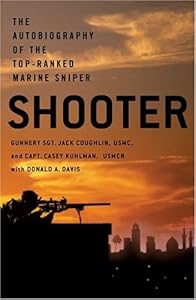
KCR: Shooter (autobiography, sniper, non-fiction, war)
Cover via AmazonShooter, by Sgt. Jack Coughlin, is an autobiography by the top shooter in Iraq, with 60+ confirmed kills. He was there when they pulled down the Saddam statue that ended up on TV. He was in Somalia, and everywhere else there is a need for a good marine.This book is not as jingoistic as one may suspect, but another warrior's memoir. The man is plain-spoken, and Donald A Davis helped polished up the prose quite a bit, having previously published several history books and crime books. The officer Casey Kuhlman also contributed a lot of the facts and recollections for overall perspective.
The book is about the conditions of the job, and the comraderie and trust between warriors, not about the tally of the kills and such. This also serves as a first-person account of Battle for Baghdad. Most Iraqis are glad to see the Americans topple Saddam... at least at first.
If you like the warrior memoirs, you need to pick this one up.
Rating: get it
Labels:
Iraq,
Jack Coughlin,
Non-Fiction,
Saddam Hussein,
Sniper
Monday, May 23, 2011
KCR: Freakonomics (non-fiction, economics)
Image via WikipediaLevitt and Dubner's book Freakonomics is a ground-breaking book where the pair examined the economics in some very interesting subjects, such as cheating in public schools, illegal drugs, sumo wrestling, and more. The exotic subjects are the hook, and it pulls you in as it also manages to teach you about various economic buzz terms like "price insentive" and so on.Some of the conclusions will like offend people, as it had concluded that the drop in crime rates in the 1980's and 90's is a result of... legalization of abortion. He's got the numbers to prove it, but can he convince people?
If you can keep an open mind, you should read this book, and check out the few episodes of "Freaknomics Radio" podcast (you can find it through the Amazon link below, and on iTunes and their website).
Rating: Read it
(though you can skip the movie, it's kinda lousy)
Labels:
Economics,
Non-Fiction
Sunday, May 22, 2011
KCR: The Next 100 Years (non-fiction, forecast)
Next 100 Years attempts to forecast the next 100 years, and while a lot of the political analysis makes sense, it comes across as a jingoistic declaration of American superiority borrowing elements liberally from military thrillers with power combat suits, hypersonic fighters and cruise missiles, even armed space stations (I guess they work off the same sources).
It is interesting to figure where the predictions came from, as the author details how he sees "nationalistic needs" and how they influence geopolitics and future conflicts. Basically, each country has its own version of "manifest destiny". For the US, it was to control access to both oceans (and later, guarantee access to oil). For Japan, it is the need to secure natural resources to feed its industries. For Russia, it is to protect itself from invasions by dominating its surroundings, and that means it will collide with China in the very near future.
You may or may not agree, but it does make sense... to a certain degree.
Rating: Try it
It is interesting to figure where the predictions came from, as the author details how he sees "nationalistic needs" and how they influence geopolitics and future conflicts. Basically, each country has its own version of "manifest destiny". For the US, it was to control access to both oceans (and later, guarantee access to oil). For Japan, it is the need to secure natural resources to feed its industries. For Russia, it is to protect itself from invasions by dominating its surroundings, and that means it will collide with China in the very near future.
You may or may not agree, but it does make sense... to a certain degree.
Rating: Try it
Labels:
Forecast,
Future,
Non-Fiction,
United States,
World
Saturday, May 21, 2011
KCR: The Much Too Promised Land (non-fiction, memoir, Middle East)
| Aaron David Miller |
His insights in the chaotic situation, where different factions of Palestinians and Israelis vie to international attention, and how the extremists (on both sides) disrupt negotiations with violence, is very sobering.
The characters are real, the situation all too true, full of egos that must be soothed. And the best part... he took NO SIDES. He was tough on both sides, and pointed out the fallacies of having a conflict that lasted decades.
People with their mind made up will find this book infuriating, because the book was "one-sided" when it's not. For people who are willing to keep an open mind, this book is a fascinating peek into the world of diplomacy, and ultimately, Middle East peace.
Rating: Read it (at least once)
Related articles
- What Are The 1967 Borders? (npr.org)
Labels:
Diplomacy,
Middle East,
Negotiator,
Non-Fiction,
Palestine
Sunday, May 15, 2011
KCR: Foreign Babes in Beijing (memoir, China)
Rachel DeWoskin was recruited through a friend to act in a Chinese TV series about non-Chinese women (read: European or American) seducing and eventually marrying Chinese men. This made her a household name (well, at least her character, "Jessie"). This leads her into a very intimate look into the mindset of Chinese. When the Yugoslav Chinese Embassy was accidentally hit with a missile, the country's mood changed overnight, and you can't be an American anywhere in public in China.
If you are interested in Chinese culture and you're not Chinese, you should read this book.
Related articles
- Rachel DeWoskin, author of Big Girl Small, answers Ten Terrifying Questions (booktopia.com.au)
- Book Notes - Rachel DeWoskin ("Big Girl Small") (largeheartedboy.com)
Labels:
China,
Memoir,
Non-Fiction,
Rachel DeWoskin
Tuesday, May 10, 2011
KCR: Don't Know How Much About Anything (non-fiction)
Cover via Amazon |
This is basically stuff you could have found in Wikipedia, but never had a chance to. It's just a bunch of questions, and short answers, presented in a quiz format.
The problem here is some of the information given as answer is actually false, or wrong, or outdated.
Unless you've a trivia buff, you don't need this book, and even then you may want to double-check the numbers.
Rating: skip it
KCR: Kill Bin Laden (non-fiction, history, military)
Cover via AmazonNow that Osama Bin Laden is finally dead, some people may wonder what took the US so ****ing long. The answer is in the book "Kill Bin Laden" by Dalton Fury. (clearly a pen name)Dalton Fury is the on-scene commander of the Delta Force contingent in Afghanistan on the hunt for OBL. He lead like 40+ Delta Boys, and about 90+ other contingents including SAS, SBS, CIA, and many more. The short of it is... we were TOO nice to the friendlies, who are eager to take our money instead of deliver results.
Did you know that our "allies" leave the mountain every evening, so any "territory conquered" by them was given up?
Did you know we have two factions of allies "fighting" each other? And one of them is probably in cahoots with the Taliban, and declared a "cease-fire and surrender", which is probably how OBL got away.
Did you know that OBL got away in Winter, which is VERY harsh in the mountains of Afghanistan? Geraldo Rivera's "report" is all bull****, since he did it in the summer.
If you are interested in the hunt for Bin Laden on Tora Bora at all, you should read this book.
BTW, Kathryn "Hurt Locker" Bigelow is turning this book into a movie due in 2012, and now they have a new chapter to add.
Rating: read it!
Related articles
- Kathryn Bigelow was already working on 'Kill Bin Laden' before the U.S. killed Bin Laden (insidemovies.ew.com)
Labels:
Afghanistan,
Dalton Fury,
Delta Force,
Kill Bin Laden,
Non-Fiction,
Osama BinLaden
Sunday, May 8, 2011
KCR: Why People Believe Weird Things (non-fiction)
| Michael Shermer |
The problem with this book is it got a little long-winded, as if Shermer needs to go into every last bit that's related to the topic. This book went into a history of creationism (now called intelligent design, , and history of holocaust denial (i.e. pseudo-history, attempt to perpetuate fake history), though knowing the history doesn't really help us understand WHY they would continue to hold those ideas.
On the other hand, the analysis into the tactics used by pseudo-science and pseudo-history is interesting.
Worth a look, just to see how those scammers work.
Related articles
- Michael Shermer: Baloney Detection Kit (thegreatone22.wordpress.com)
Saturday, May 7, 2011
KCR: DSI - Date Scene Investigation (non-fiction, dating)
DSI offers up dating advice with some "profiles" done in the style of CSI. The author, Ian Kerner, had previously written a few books about the psychology of dating and this time, he and his fellow DSI's will go through various "cases" of date dilemmas and dating disasters and identify the various problems, and hopefully help you avoid the same.
The style is written pseudo-serious with a lot of puns and sarcasm, and even goes into background info and various like and dislikes, plus previous bad dates. There's even a quiz at the end.
If you like a humorous look at dating, with a bit of practical advice thrown in, this may be up your alley. If you are looking for serious advice, avoid this book.
The style is written pseudo-serious with a lot of puns and sarcasm, and even goes into background info and various like and dislikes, plus previous bad dates. There's even a quiz at the end.
If you like a humorous look at dating, with a bit of practical advice thrown in, this may be up your alley. If you are looking for serious advice, avoid this book.
Labels:
advice,
dating,
Ian Kerner,
Non-Fiction
Thursday, May 5, 2011
KCR: Superfreakonomics (non-fiction)
Cover via AmazonSuperfreakonomics by Levitt and Dubner are about surprising stories behind statistics, about how "common wisdom" are anything but, as it answers questions such as:- How is a street prostitute like a department-store Santa?
Answer: they are both seasonal employment - What's the best way to catch a terrorist?
Answer: data-mine their economic patterns
And many other weird questions that you never thought people would have analyzed, but probably should, as it completely challenges the way you thought things worked.
This is a sequel to Freakonomics, which discussed a lot of controversial ideas, like what actually caused the drop in crime in the last 20-30 years (his answer: abortion). This sure pushed a lot of people's buttons and a ton of blogs, articles, op-eds, and such were written to "debate" or "debunk" Freakonomics (and now, Superfreakonomics).
You are not expected to agree, but at least, you need to keep an open mind when you read these, as they do make sense on many levels. Some of the logic is weak, while at others there's a bit of psychology thrown in, but it is still interesting.
Rating: Get it
Subscribe to:
Posts (Atom)